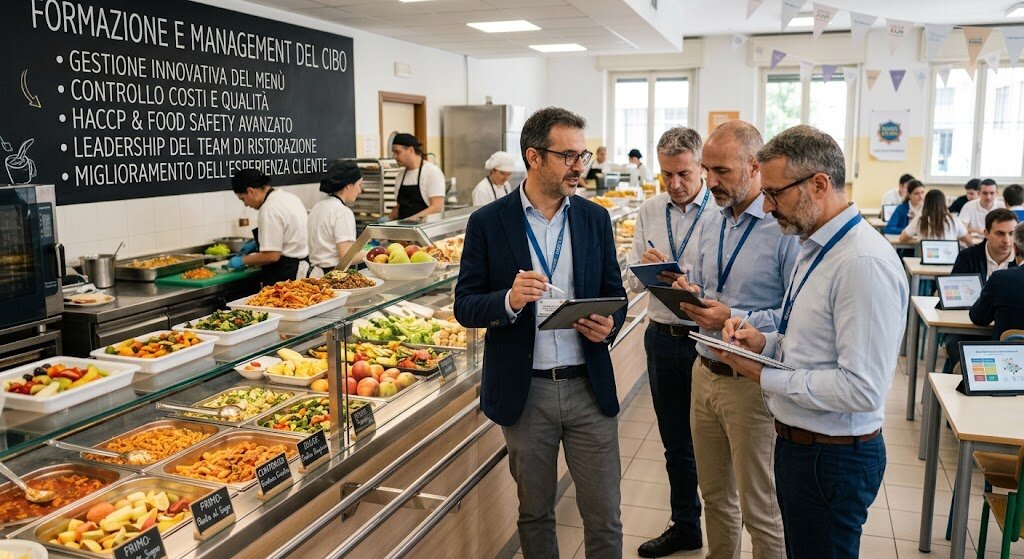

The contract catering sector is undergoing a profound transformation, tasked with balancing service quality, sustainability, training, and industrial capacity. It is against this backdrop that RestaCOVE emerges—a European project designed to establish new pathways for professional excellence and guide school, hospital, university, and corporate canteens toward more advanced operational models.
By engaging businesses, universities, and institutions, the program aims to redefine the skills, standards, and tools that will shape the sector’s future. In this exclusive interview with Italia a Tavola, Paolo Valente—Director General of ANIR Confindustria (the National Association of Contract Catering Companies)—analyzes the sector’s challenges, the strategic role of training, and the need to turn sustainability into a tangible driver of development.
Interview with Paolo Valente, Director General of ANIR Confindustria
Director General Valente, ANIR Confindustria is a partner in RestaCOVE. How did this partnership come about, and how does the European project address the needs of the contract catering sector?
At a time when Italian dining is achieving great success and recognition, RestaCOVE allows us to clarify the role of contract catering and large-scale food service operations. ANIR is working to make the industrial, organizational, and professional dynamics of companies that produce and supply meals to the community more transparent and understood. We have long been engaged in a structured dialogue on these issues with the Università Cattolica del Sacro Cuore in Milan. The European project addresses a specific need: aligning training, skills, and industrial transformation. Institutional and large-scale catering involves more than just the preparation and serving of meals; it is a system that ensures continuity, food safety, nutritional quality, and a daily presence in schools, hospitals, businesses, and communities. ANIR participates in RestaCOVE to represent the voice of businesses and the sector’s practical experience.

RestaCOVE focuses on sustainability, skills, and innovation. Why are these themes central today?
Because they determine the very ability to deliver the service. Sustainability encompasses supply chains, waste reduction, energy, logistics, environmental criteria, and the quality of work. Innovation means using data, traceability, and monitoring tools to plan better, reduce inefficiencies, and make quality measurable. Skills act as the connecting link in a labor-intensive sector. Without trained personnel and companies capable of managing complex processes, sustainability and innovation remain valid concepts, yet lack real strength.
Training and sustainability: the new skill sets in contract catering
It is not enough to simply train cooks and kitchen staff. Is this the new professional landscape of the sector?
It is already the actual landscape of the sector. Cooks, dietitians, nutritionists, and operational staff remain crucial figures. Yet, surrounding them is a broader chain of competencies: procurement, quality control, food safety, logistics, sustainability, contract specifications, contract execution, and data analysis. Quality does not originate solely on the plate; it stems from service design and the ability to organize supplies, schedules, personnel, checks, and standards. That is why training must accompany the entire process.

How can sustainability become a practice that is also economically viable?
Sustainability becomes a practical reality when built upon clear objectives, verifiable indicators, and consistent economic conditions. An essential service cannot rest on statements of principle alone; it requires organization, accountability, and continuity. What is needed are realistic specifications, measurable quality criteria, controllable supply chains, proper execution management, and tools that maintain the balance of contracts over time.
The challenge lies not in adding obligations, but in balancing environmental quality, social quality, and economic sustainability. ANIR has taken a clear stance on this, including through guidelines on the sector’s sustainable value chain designed to highlight what companies are already doing: social reporting, legality ratings, service sustainability ratings, energy efficiency measures, waste reduction, and adherence to Minimum Environmental Criteria.
RestaCOVE: skills and value for the sector
What legacy should RestaCOVE leave for the sector?
Three outcomes: recognizable professional profiles, shared standards, and greater awareness of the value of institutional catering as a form of public food provision. This result can emerge from an exchange of experiences with Mediterranean Europe and will find a focal point in the Centre of Professional Excellence. We are talking about a service that impacts health, education, employment, social inclusion, and quality of life. If RestaCOVE helps clarify this role, it will have achieved a result that is beneficial not only for businesses but also for the country and Europe.