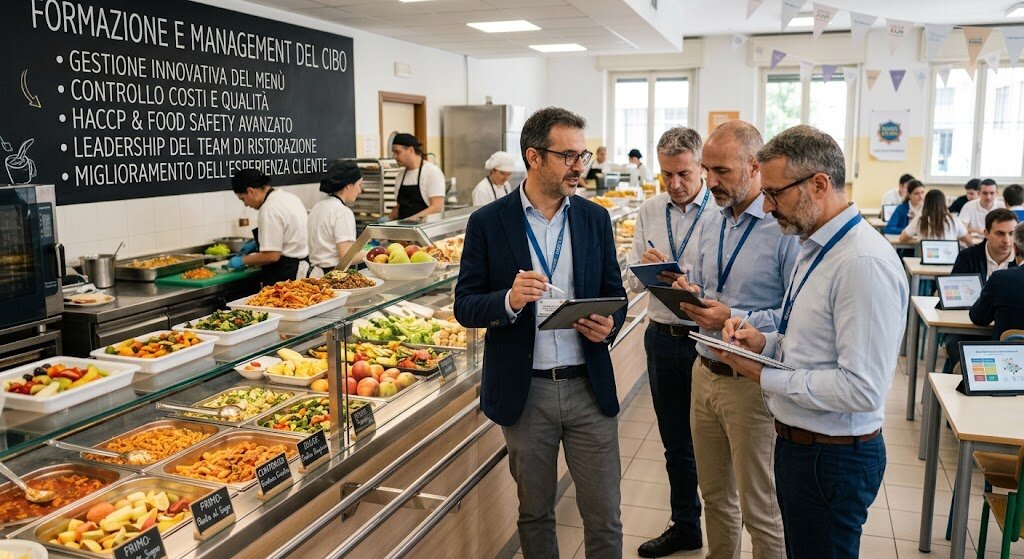


Often overlooked in public debate, the sector comprising school, workplace, and hospital canteens now represents a strategic part of the European food system’s infrastructure, with direct impacts on public health, nutritional education, and sustainability. Against this backdrop, RestaCOVE is taking shape—a European project linking universities, businesses, and vocational training providers with the aim of developing new skills, professional profiles, and organizational models for the future of institutional catering.
Professor Michele Filippo Fontefrancesco of the Università Cattolica del Sacro Cuore in Milan—the project’s lead partner—discusses the project’s rationale and the transformations underway in the sector with Italia a Tavola. From the role of training and micro-credentials to new partnerships between research and industry, the outlined path aims to make the sector’s evolution more concrete and structured.
Interview with Professor Michele Filippo Fontefrancesco

Professor Fontefrancesco, RestaCOVE was created to make European collective catering more sustainable. What specific need gave rise to the project?
A close look at Italian dietary habits reveals that the collective catering sector forms the backbone of Italy’s entire food system: one billion meals served annually, a total turnover of approximately €6 billion, over 1,500 active companies, and around 100,000 workers employed in the sector on a daily basis.
This sector plays a pivotal role not only in Italy but across Europe. Yet, despite this, both Italy and the rest of Europe lack a strong, structured, and clear link between the collective catering industry and vocational or university education. RestaCOVE was launched precisely to bridge this skills gap and build a direct channel between the classroom and the world of work.
Canteens are often perceived as a routine, almost invisible service. Why, instead, can they become a crucial laboratory for the food transition?
Having a meal in a canteen is a collective act that affects millions of people every day—from preschool children and workers to hospital patients. This scale demonstrates the potential impact when the sector takes a leading role in sustainability: through education, raising awareness, and improving efficiency. To achieve this, however, the sector requires support—specifically through training programs that integrate sustainability issues into the daily operations of businesses.
The new skills required for sustainable institutional catering
The project focuses on training, micro-credentials, and skills. Which professional roles will be most important for building a truly sustainable collective catering sector?
The transition to sustainability can only be achieved through a collective effort involving all workers, from operational staff to management. The RestaCOVE project targets a diverse range of roles, spanning operational, technical, and managerial positions. To this end, the project introduces 18 certified micro-credentials, enabling these workers to gain recognition for specific skills that are valuable across the European market.

The RestaCOVE project will involve all workers in the collective catering sector, from operational roles to management positions.
In the food service sector, sustainability goes beyond just ingredients or menus. Which organizational aspects need to change: procurement, waste, energy, data, logistics, or service management?
Sustainability must encompass the entire business model—starting with procurement and logistics by supporting local partnerships and processes aimed at enhancing quality and reducing emissions; moving to data management, where historical data and predictive algorithms are used to eliminate overproduction and manage surpluses; and finally addressing energy efficiency through the adoption of new technologies and the transition to renewable energy sources.
Universities and businesses join forces for the future of European canteens.
RestaCOVE brings together universities, vocational training providers, businesses, and industry representatives. What can emerge from this alliance between research, training, and the market?
This partnership has given rise to a Center of Professional Excellence that combines academic theory, the practical application of vocational training, and real-world market needs. This synergy will make it possible to overcome the isolation of businesses regarding training, generate research applied to industry challenges, and shape “Green Careers” for young people. This is no mere dream; it is a concrete project and a journey that began in April of this year.