

The Erasmus+ RestaCOVE project transforms institutional catering into a sustainable model through micro-credentials and vocational training.

The European project RestaCOVE, coordinated by the Università Cattolica del Sacro Cuore with the participation of ANIR Confindustria, represents a significant step forward for the collective catering sector. Its goal is to transform food service management into a sustainable model based on recognizable skills, assessable standards, and efficient organization. Launched on April 1, 2026, and scheduled to run for four years, the project involves 18 organizations across six countries: Italy, Greece, Slovakia, Romania, Turkey, and Malta. The aim is not merely to enhance sustainability but to translate it into tangibly measurable operational capabilities.
Micro-credentials and training for recognizable skills
A key element of the project is the design of 18 micro-credentials—tools that make it possible to recognize specific skills acquired through targeted training experiences and verified against transparent criteria. Linked to EQF (European Qualifications Framework) qualifications, these credentials are designed to support lifelong learning, professional mobility, and personnel recruitment. Simply attending a course is not enough; it is essential to know the expected learning outcomes, how they are assessed, and the professional context in which they can be applied.
The micro-credentials span professional profiles ranging from EQF levels 3 to 7, covering operational, technical, and managerial roles. Their value hinges on the precision with which they are developed and tested. Clear learning outcomes can facilitate more transparent career progression pathways and improve service organization. However, the project is still in its early stages; objectives such as needs analysis, educational models, on-the-job training activities, and digital tools remain to be developed and validated over the four-year period.
Sustainability is achieved through daily work
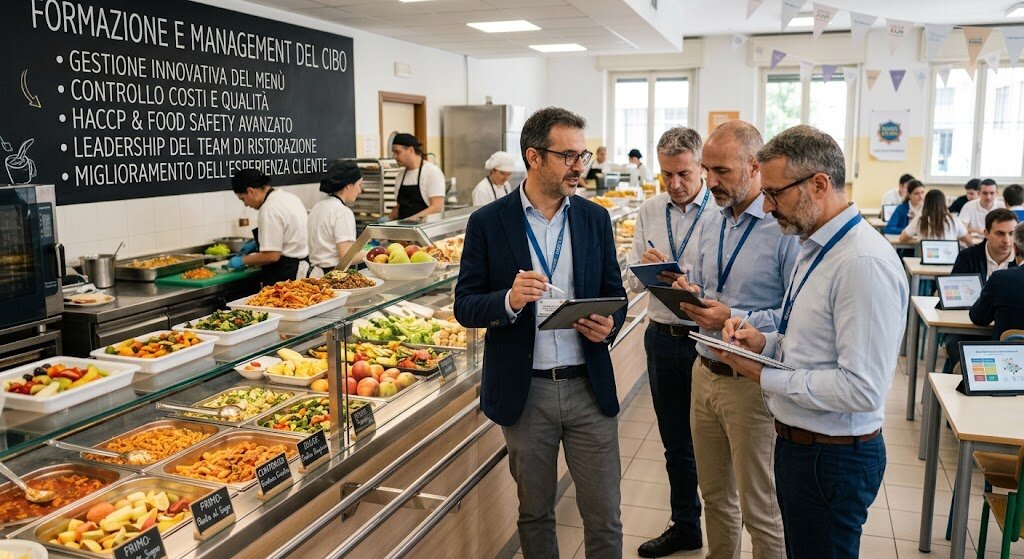
Sustainability is measured not only by environmental data but also by the daily work of those in the collective catering sector. The project’s scientific coordinator, Michele Filippo Fontefrancesco, emphasized that “the transition to sustainability is achieved only through a collective effort, involving all workers, from operational staff to management.” This approach is reflected in activities such as meal forecasting, surplus management, energy and water consumption monitoring, supply chain traceability, and food safety. Every aspect of the service must be underpinned by clearly defined and recognizable skills.
The digital dimension—such as consumption forecasting or traceability—is useful only when information is accurate, roles are clearly defined, and personnel know how to interpret deviations. Technology, after all, yields quality results only when the underlying information is correct, roles are defined, and staff can interpret variances. For this reason, on-the-job training becomes an integral part of the organization rather than an ancillary activity. Public food services should always be viewed as a component of daily social welfare. This issue also concerns public procurement authorities; tender specifications and evaluation criteria can better recognize training, technical expertise, and organizational capabilities when professional profiles are described in a clear and verifiable manner. Service quality is not merely measured after the fact; it is built beforehand—through the definition of required skills, established procedures, the ability to document execution, and the implementation of controls.
RestaCOVE will be judged on this basis: its ability to translate European objectives into practical tools for businesses, workers, vocational training providers, and public administrations. That is the only arena where the project can truly measure its impact. The participation of ANIR Confindustria—representing Italian collective catering companies—is crucial for linking the project to the public food service system. The goal is to establish Public Food as a recognized value—not merely as a service, but as an infrastructure of everyday welfare.