

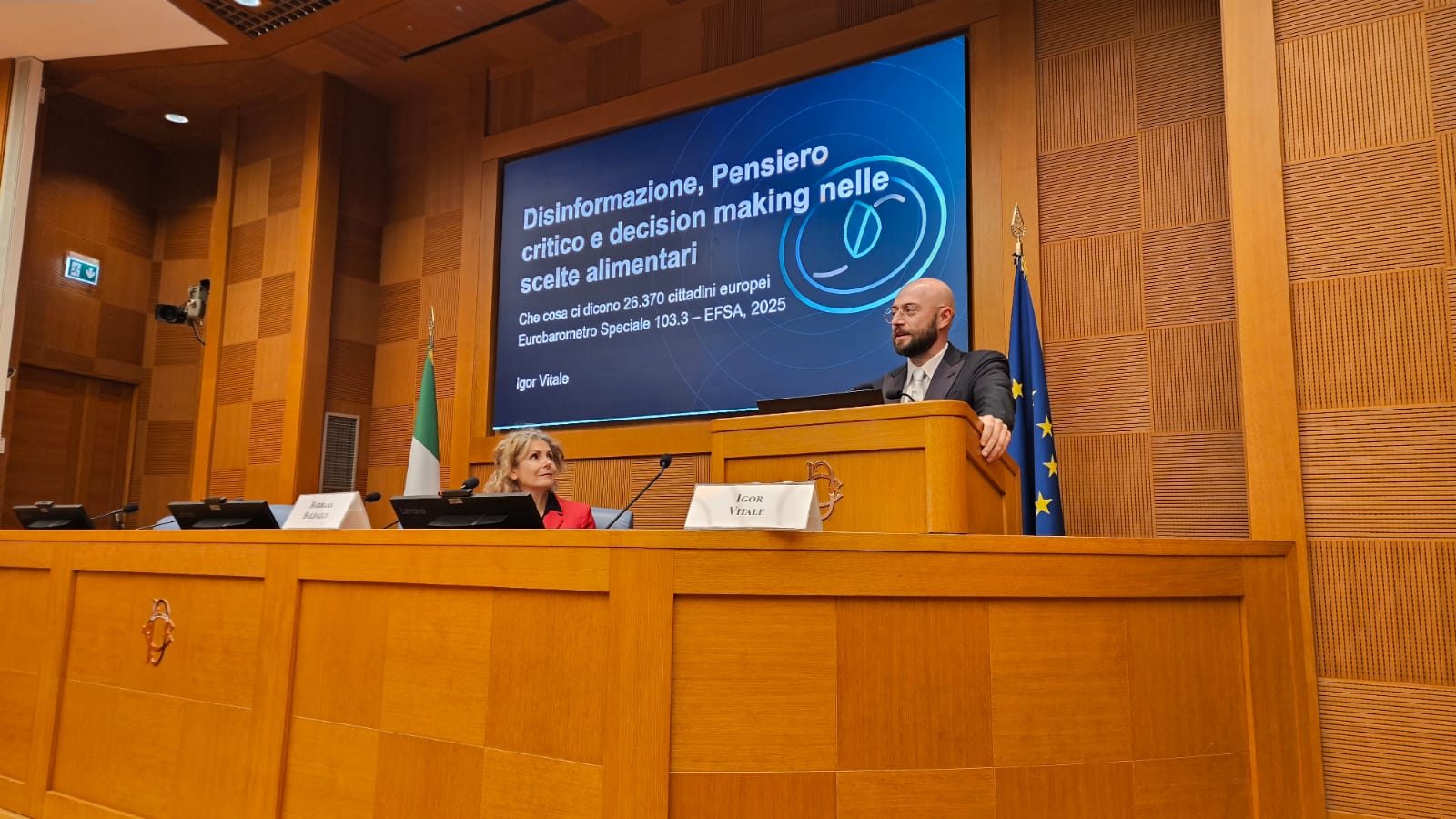
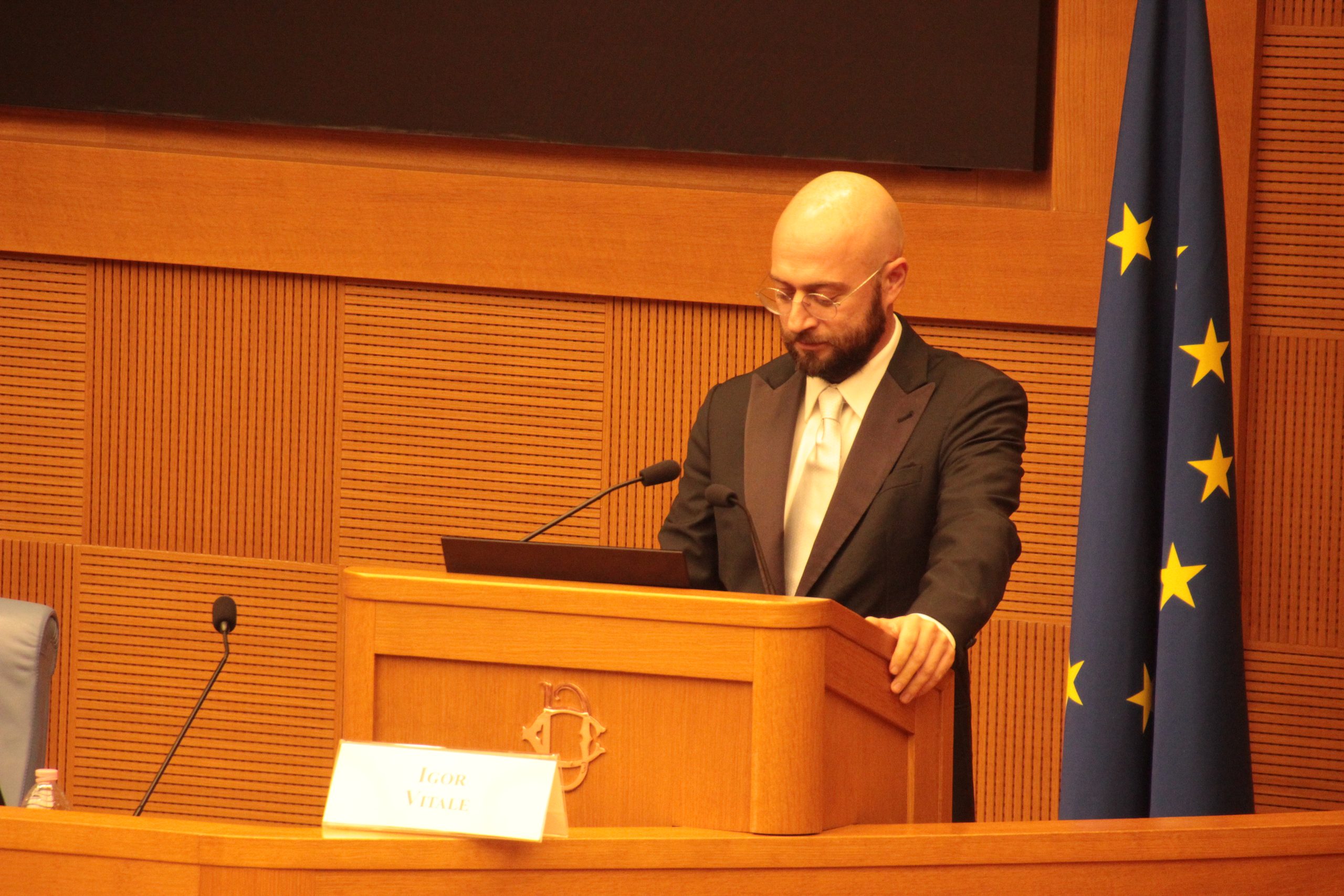
On 19 November 2026 I had the pleasure of speaking at the conference “Information, Disinformation, Statistical Literacy and Critical Thinking in the Digital Age”, held in the Aula dei Gruppi Parlamentari in Rome. In my talk I presented the Erasmus+ Centre of Vocational Excellence RestaCoVE as a good practice for encouraging healthy and sustainable food consumption through nudges.
A conference on information, disinformation and critical thinking
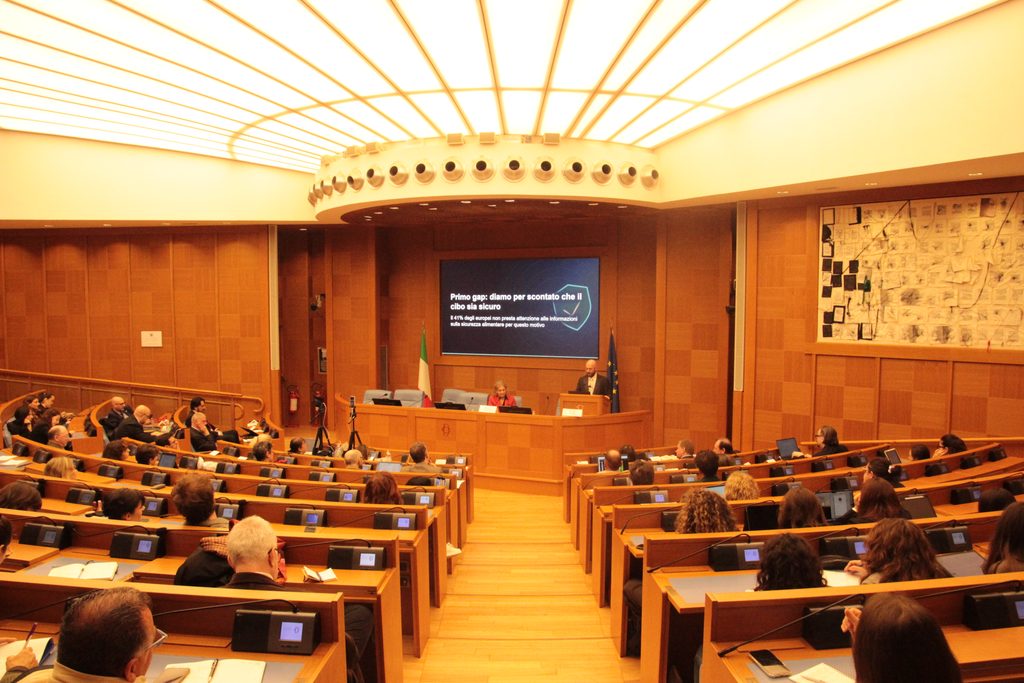
The conference was held in the Aula dei Gruppi Parlamentari of the Italian Chamber of Deputies, in Via di Campo Marzio 78, Rome. It was organised by Sapienza University of Rome – Faculty of Letters and Philosophy, Department of European, American and Intercultural Studies (SEAI) and the degree programmes in Tourism Sciences and Sustainable Tourism Sciences ).
The day brought together philologists, historians, psychologists, physicians, statisticians and experts in artificial intelligence. After the institutional greetings of Hon. Fabio Porta and Prof. Arianna Punzi, and the opening by Prof. Simona Perone on “elegant” disinformation, the programme moved from the roots of disinformation and the power of words to the role of algorithms, AI and data in democratic life. The audience included university students, researchers, journalists and representatives of public institutions, and students could earn 2 university credits (ECTS) by attending.
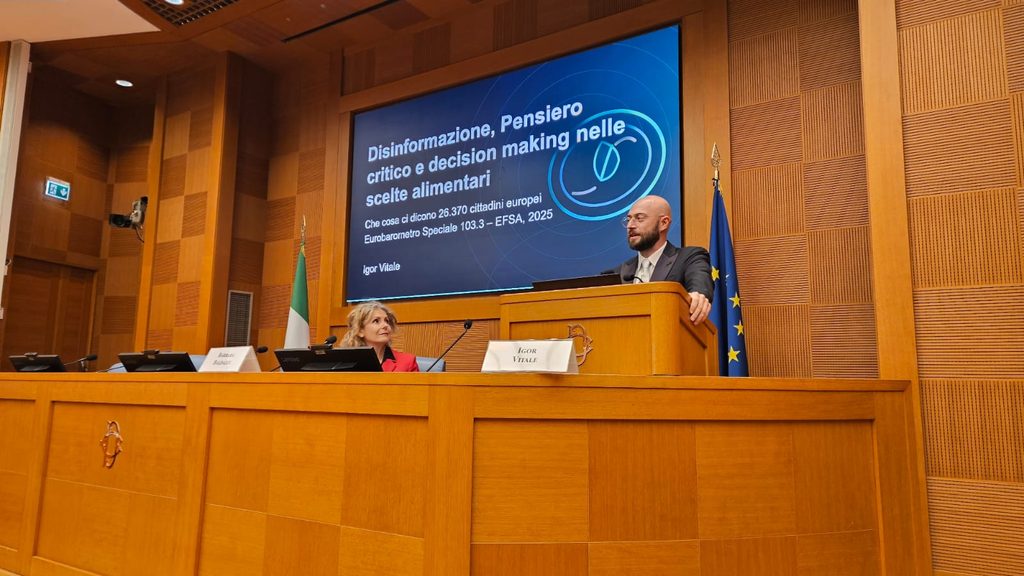
I spoke in the session “Disinformation between mind, science and technology: understanding risks, building trust”, moderated by Prof. Barbara Baldazzi, alongside colleagues addressing disinformation in vaccines, medicine, AI and the media. My contribution focused on a field that touches every citizen several times a day: food.
What 26,370 Europeans tell us about food choices
The title of my talk was “Disinformation, critical thinking and decision-making in food choices”. I started from official data: the Special Eurobarometer on food safety requested by the European Food Safety Authority (EFSA), based on 26,370 interviews in the 27 EU Member States in spring 2025.
The first finding is clear. When Europeans decide what to eat, cost comes first (60%), followed by taste (51%), food safety (46%), geographical origin (42%) and nutritional content (39%). Environmental and climate impact (15%) and ethics and beliefs, including animal welfare (14%), come last. The trend is going in the opposite direction from the one we would want: cost has gained 6 points, while origin, nutrients, environment and ethics are losing ground, and cost is the first factor in 20 Member States out of 27.
Italy is an interesting exception. It is one of only two countries where food safety ranks first, joint with geographical origin (both 55%), while cost weighs much less than the EU average (44% versus 60%).
I then highlighted five knowledge gaps that create fertile ground for food disinformation:
- Trust that becomes inattention. 41% of Europeans do not pay attention to food safety information because they take it for granted that the food on sale is safe. The system works so well that people stop looking.
- Language that is too technical. 27% find food safety information too technical. When science is not understandable, someone else fills the space.
- Classic topics that remain unknown. Around one in three Europeans are not familiar with pesticides (33%), additives, colourings and preservatives (29%) or antibiotic residues in food (36%).
- A generational gap. Social networks and blogs are a main source of information on food risks for 48% of 15–24-year-olds, compared with 13% of people over 55, and young people also trust celebrities, bloggers and influencers more (31% versus 18%).
- Inequality. Among people who often struggle to pay their bills, cost drives food choices for 74% and nutrition only for 30%. Education matters too: nutrients are considered by 45% of those who studied longest, against 32% of those who left school at 15.
Why we do not choose rationally: System 1 and System 2
Why do we choose mainly on cost and taste? Not because we are superficial. As a psychologist, I find the answer in behavioural science. Herbert Simon, Nobel laureate, described our rationality as bounded: time, attention and computing capacity are scarce, and in front of a supermarket shelf with hundreds of products we decide in a few seconds.
Daniel Kahneman, also a Nobel laureate, described two systems of thinking. System 1 is fast, automatic and emotional, and we use it almost all the time. System 2 is slow, effortful and analytical, and we activate it rarely because it costs energy.
Cost and taste are typical System 1 decisions: their consequences are immediate and certain. If I spend too much, I feel it in my wallet now; if I do not like a food, I feel it in my mouth now. Nutrition and food safety, on the other hand, require System 2: reading a label, comparing sugars and fats, understanding a risk. And the benefit does not arrive today, it arrives in ten or twenty years, in the form of longevity and years lived in good health. Our brain struggles to give weight to a harm it cannot see.
This is exactly why disinformation often wins. It speaks to System 1: a thirty-second video, a strong emotion, a simple message. Science speaks to System 2, with data and probabilities. It is not a fair fight.
From slow choices to fast signals: the logic of nudges
The central message of my talk was this: we cannot ask every citizen to think slowly in front of every shelf, but we can make the right choices fast. This is the logic of nudges, as defined by Richard Thaler and Cass Sunstein: small changes in the way choices are presented that make the healthy and sustainable option the easiest, most visible and most attractive one, without forbidding anything and without restricting freedom of choice.
I illustrated this approach with the work carried out by Igor Vitale International in more than 20 European food projects, under Erasmus+ and Capacity Building, organised around three strategies:
- Clear and fast signals. With Food Labelling (10 organisations in 9 countries) and GeoFoods, in the Maldives and the Seychelles, we work on ethical and green labels that can be understood in a few seconds. With AgriXplainer, recognised as a good practice, and Renaissance of Local Food, we explained green practices and local food through educational marketing. The same approach informs our work with schools and teachers in EU-Micronesia on motivation towards blue and green careers.
- Making what is healthy and sustainable also delicious. If taste decides, let us use taste. With Wild Herbs and Ethnobotany in Haute Cuisine, Seaweed Power, GrainFermentED, Edible Cities and our work on forgotten fish from artisanal fisheries, we work with chefs and young people so that the sustainable and nutritious choice also becomes the tastiest one.
- Designing the choice environment. This is where RestaCoVE comes in.
RestaCoVE: a good practice for healthy and sustainable collective catering
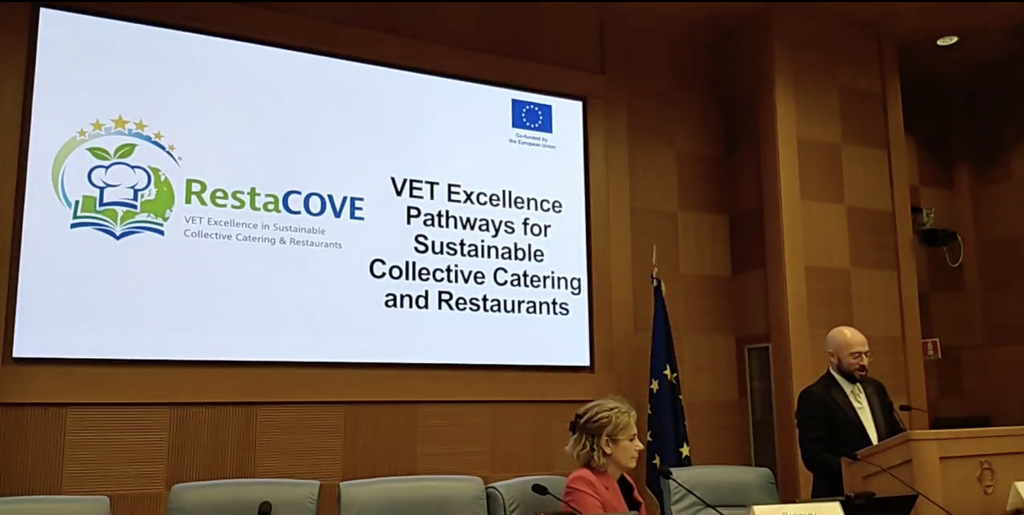
RestaCoVE – VET Excellence Pathways for Sustainable Collective Catering and Restaurants – is a European Centre of Vocational Excellence (CoVE) funded by the Erasmus+ programme, running from April 2026 to March 2030. Igor Vitale International is a partner and leads Work Package 2.
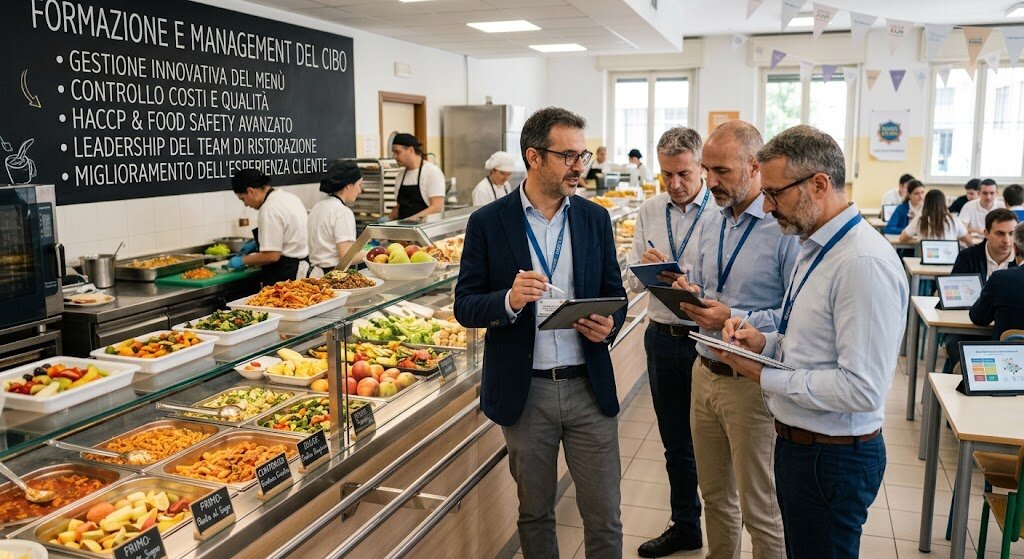
The project trains the people who work in canteens, collective catering and restaurants: school, university and company canteens, hospitals and care facilities, where millions of people eat every day without really choosing. This is the key point. In collective catering, the menu is the choice environment. Whoever designs the menu, the order of the dishes, the default options, the portion sizes, the names and descriptions of the dishes and the way food is displayed along the counter is already shaping what thousands of people will eat. If the menu is healthy and sustainable, the right choice becomes automatic.
For this reason RestaCoVE is, in my view, a concrete good practice for translating behavioural science into everyday food policy. Instead of asking consumers to read more information, it invests in the skills of the professionals who build the choice architecture. Training cooks, managers and frontline staff in sustainability and in the psychology of food choices means acting where System 1 decisions are actually made.
Within the project we have started with a needs analysis, including focus groups with managers and frontline workers in collective catering in Foggia and Puglia, to understand the real constraints of the sector. Building on this, one of the training scenarios I am developing for the project’s Virtual Learning Factory focuses on the neuroscience of food: how menu architecture in a university canteen can encourage healthy and sustainable choices and, at the same time, educate students to make more conscious food decisions.
Food awareness is not only communicated. It is designed.
I concluded my talk with a simple idea. Europeans are interested in food safety, but they choose with System 1. Giving more information is not enough: we need to design choices in which what is healthy, safe and sustainable is also simple, tasty and immediate. In the fight against food disinformation, critical thinking remains essential, but it works best when it is supported by environments that make good decisions easy.
I would like to thank the organisers of Sapienza University of Rome, the moderators and the speakers for a rich and genuinely interdisciplinary day, and all the participants for their questions and attention.
Dr. Igor Vitale – psychologist, founder of Igor Vitale International srl
RestaCoVE (VET Excellence Pathways for Sustainable Collective Catering and Restaurants, project no. 101260578) is co-funded by the Erasmus+ Programme of the European Union. Views and opinions expressed are those of the author only and do not necessarily reflect those of the European Union or the European Education and Culture Executive Agency (EACEA). Neither the European Union nor the granting authority can be held responsible for them.